I remember saying to a teacher friend once that I wanted to work at a charter school. I didn't really know why, I was just sick of public school drama, and after only two years in it. They asked why on earth I would want that, and I thought it was weird for them to ask with such incredulity. I guess I didn't really know much about them besides the things I had heard from movies and the general media. "The best charter schools are the only viable solution to America's failing public school system." "Charter schools are more progressive." Large companies like Wal-mart fund the growth of charter schools, making them spread like a cancer throughout urban areas that have poor schools. Waiting for Superman shows students and parents clutching raffle tickets tearfully hoping to snag one of the few open spots in a new charter school.
In her article, Ravitch points out that only one in five charter schools actually achieves the "amazing results" it claims. A Stanford economist ran that study, looking at student progress on math tests at 2,500 charter schools. They found that only 17 percent of those schools were "superior to a matched traditional public school;" surprisingly, "37 percent we worse than the public school." So what about charter schools make these poor families think that these schools are their son or daughter's only hope?
I've seem this movie myself, and it really does gloss over this glaring fact. Which makes me think about the "central dogma" of the film which purports that the teacher is the most important part of a child's success. If charter schools are hiring "the best teachers" then how is it that these schools are not making a significant difference in achievement? This is where we must turn to education reform and not educational "silver bullets" like charter schools. Ravitch points to several different studies that show external factors to be far greater risk factors for lower student achievement. Another economist found that 60 percent of achievement is explained by things such as family income that teachers and schools have no control over.
I think it is fascinating that the president of a labor union for teachers (American Federation of Teachers, AFT) is considered the founder of the idea of charter schools, but not in the way we recognize them today. In 1988, Albert Shanker wanted to collaborate with public schools to create small schools that would focus on the highest risk children. When the idea was snatched by for-profit organizations, he changed his mind. And that's really crappy too, because schools fot at-risk children seem like they could be beneficial... until you bring profit and business into it. Charter schools are definitely not looked at as a collaboration with public schools, but as a better alternative to them. This article has really opened my eyes to charter schools and the myths propagated about them.I don't want to be part of a school system that pushes their students because of NCLB, or one that has greater funds than any given public school. I don't want to be part of a school system that drops or expels students because they will bring a test average down. Reform has to start with the children, not the testing.
So I think it's important to look at those "other factors" when considering education reform. If 60 percent of achievement has nothing to do with the school, then we have to look at things another way. Finland is a great example of reform that went in the right direction. They didn't fire bad teachers, they worked to make them better. They built a national curriculum that includes more than just math and reading. As a science teacher, I whole-heartedly agree with this, and just downright love it. They also boosted welfare programs for families. To me, this is a key factor in their success. By strengthening aid to families, you minimize that gap that exists, at least financially. I don't know whether Finland's aid program involves helping parents find jobs or anything like that, but I think that's really important as well. I have seen welfare abused in many different situations and many different ways, and it pains me to know that children are watching their parents be dependent and learning from that. I want education and assistance to parents and families so they can get back on their feet; not become dependent on, and take advantage of, the system.
Of course, we don't have welfare reform yet, and so we have to look at education from where we are. My new school has a program in place this year called BARR (Building Assets, Reducing Risks) that comes from the Search Institute and is funded by some fancy grant we won. The school had been piloting it with a few small groups last year, and now they're prepared to go "whole hog" with it. It follows a social-emotional curriculum that aims to create a positive school climate for children. It helps teachers to be aware of factors such as home life, self-esteem, substance abuse and economic status that could have a detrimental effect on a student's successful development of "assets." These assets are broken into two categories: those that students have from birth (such as family support), and those that can be developed (such as commitment to learning). The focus is 100% on freshmen, who are the most at-risk according to the program. As teachers of freshman, there will be teams who have the same set of kids, and we'll meet weekly to discuss each of them and any concerns we have.
This is very different than any other teamwork I've done in schools, and much like horizontal teaming that I've heard about in middle schools. Since I've worked only in high schools, I've only ever experienced vertical teaming, where all the science teachers get together to complain. This format is really only helpful to upper level teachers who could potentially ask the previous year's teacher about a student, which they generally don't bother to do. And of course, they don't get input from any other current teachers. At the training for BARR, I compared these meetings to IEPs, because I feel like that is the only place I have ever been able to "compare notes" with a student's other teachers. I have high hopes for it, I just hope it doesn't take up too much of my valuable prep time!

The endeavors of a spirited teacher who hates wearing shoes. Follow me as I navigate teaching, chemistry, technology, grad school, vodcasting, blogging, horseback riding and more... all while trying to avoid traditional footwear (or shoes altogether).
Tuesday, August 21, 2012

Tuesday, June 28, 2011
The past two months...
So it's been a while since I've posted. Lots of stuff has happened... new house... new job. Portland, Kennebunk, respectively. It has happened very quickly too. Back in the beginning of May, I had a Skype interview with Kennebunk High School. I later found out that the new principal (who was there) thought I "came alive" on the screen and seemed very passionate. Two weeks after that interview (and another no from an interview at Massabesic Middle School), I got a call from the current principal who is going overseas this summer (hence the new principal). He asked me to join their team. I was speechless... and by speechless, I mean I was so excited that I could barely wait for him to finish his sentence to say yes.
He talked for a while more on the phone, but I was honestly too excited to fully hear him. I'm getting a great pay raise for one. I'm going to be living with my husband again. And Tangie will get to know more than being alone for eight hours a day... she'll make friends at the doggy parks of Portland! We began our search for a new apartment/house almost immediately, and found a wonderful (somewhat expensive) house on outer Forest Ave in Portland. I came down for a weekend with some stuff that I was moving out of Houlton, and we went to look at this 3-bedroom house in Riverton after Devon's baseball game. The landlords loved us, and we loved the place. The landlords also loved Tangie, which was wonderful since Tangie is very obviously a pitbull, but not very obviously a wonderful dog.
So that was around the last week of May (I think it was Memorial Day weekend). From there, I came back to Houlton for the class of 2011's graduation. Miss Sydney, their valedictorian, was in my anatomy class this year, and gave me a shout-out in her speech. I was pretty stoked to be noticed as a good teacher at that school, even if only by a single student. Later, when I was leaving for the year, and forever, I found that there were a few more people who were going to miss me. Sheesh. I don't know why, but I felt like maybe it would have been nice to be acknowledged as a valuable teacher and colleague before my last week teaching there. Oh well.
The past few weeks have flown by! I turned in my final grades, got my room cleaned out, and said my goodbyes. The guidance counselor there has been the only one to consistently support me and "boost my ego" and she was able to make me cry on my last day. Thanks, B. I was also pretty bummed to say goodbye to a few students that I would have loved to continue teaching. After my last day on June 17th, I drove myself and the rest of my stuff down to Portland forever... or at least until we move into our new place on June 30th/July 1st.
Unfortunately for my lovely roommates (one being my hubby), they'll have to do a lot of cleaning and moving over the next two days. Why? Because I presented "Wikispaces for Classroom Use" at the SAMS Summer Institute on June 23rd & 24th back in Houlton... then I came back late Friday only to pack and leave for Philly for the annual ISTE Conference. I've been here since Saturday evening, and being here has been fun, but the conference has been a waste of time. It stinks. I've been to three 1-hour sessions in two days. One of which I was pre-registered for and I didn't really like. It was just a plug for NatGeo's Beta Education site.
I'd like to talk more about the two sessions I desperately wanted to attend but were full by the time I hauled myself to the closed doors. I will do that later, but not in this post. I want to discuss why I wanted to attend more than the sessions themselves. For now, I must have a yummy Philly dinner, then MOVE into my fancy new house, then I will discuss. Take it easy, it is summer after all!
He talked for a while more on the phone, but I was honestly too excited to fully hear him. I'm getting a great pay raise for one. I'm going to be living with my husband again. And Tangie will get to know more than being alone for eight hours a day... she'll make friends at the doggy parks of Portland! We began our search for a new apartment/house almost immediately, and found a wonderful (somewhat expensive) house on outer Forest Ave in Portland. I came down for a weekend with some stuff that I was moving out of Houlton, and we went to look at this 3-bedroom house in Riverton after Devon's baseball game. The landlords loved us, and we loved the place. The landlords also loved Tangie, which was wonderful since Tangie is very obviously a pitbull, but not very obviously a wonderful dog.
So that was around the last week of May (I think it was Memorial Day weekend). From there, I came back to Houlton for the class of 2011's graduation. Miss Sydney, their valedictorian, was in my anatomy class this year, and gave me a shout-out in her speech. I was pretty stoked to be noticed as a good teacher at that school, even if only by a single student. Later, when I was leaving for the year, and forever, I found that there were a few more people who were going to miss me. Sheesh. I don't know why, but I felt like maybe it would have been nice to be acknowledged as a valuable teacher and colleague before my last week teaching there. Oh well.
The past few weeks have flown by! I turned in my final grades, got my room cleaned out, and said my goodbyes. The guidance counselor there has been the only one to consistently support me and "boost my ego" and she was able to make me cry on my last day. Thanks, B. I was also pretty bummed to say goodbye to a few students that I would have loved to continue teaching. After my last day on June 17th, I drove myself and the rest of my stuff down to Portland forever... or at least until we move into our new place on June 30th/July 1st.
Unfortunately for my lovely roommates (one being my hubby), they'll have to do a lot of cleaning and moving over the next two days. Why? Because I presented "Wikispaces for Classroom Use" at the SAMS Summer Institute on June 23rd & 24th back in Houlton... then I came back late Friday only to pack and leave for Philly for the annual ISTE Conference. I've been here since Saturday evening, and being here has been fun, but the conference has been a waste of time. It stinks. I've been to three 1-hour sessions in two days. One of which I was pre-registered for and I didn't really like. It was just a plug for NatGeo's Beta Education site.
I'd like to talk more about the two sessions I desperately wanted to attend but were full by the time I hauled myself to the closed doors. I will do that later, but not in this post. I want to discuss why I wanted to attend more than the sessions themselves. For now, I must have a yummy Philly dinner, then MOVE into my fancy new house, then I will discuss. Take it easy, it is summer after all!
Thursday, April 14, 2011
Curriculum development: Micro-scale.
First I have to mention the article I read recently from class, where they talk about the definition of the word "curriculum." They raise an interesting point because the idea of a "common core curriculum" implies different things to different people. Many people think that curriculum is "a lean set of big ideas that can be tackled in many ways." For others, it's the textbook for that course that represents the curriculum. Still others think that a common curriculum will be "scripted, day-to-day lesson plan[s]."
I find the last definition of curriculum absolutely horrifying. Do people really think that a common core curriculum would result in complete loss of control? The article goes on to point out that it would be ludicrous to create scripted lessons and leave out any teacher input. President of the Common Core organization in Washington, D.C. Lynne Munson said, "we would be fools to create materials in a process that doesn’t draw on the tremendous wisdom of a public-review process.”
So I stand on the side of common core curriculum that thinks of it as a "town common," like a place where everyone meets and collaborates. I have a lot of control in my classroom as far as curriculum goes, too. If someone came into my biology class to tell me, "you're teaching this now," I think I'd be pretty upset! In general though, because I have relatively "new" training in education, I can mold my lessons to fit into whatever curriculum or standards I am supposed to be teaching.
Adjusting to the common core standards in my classroom will be the next time I have to "make curriculum changes." A large part of the common core standards is L-I-T-E-R-A-C-Y as it relates to college and career readiness. Many of my lessons include some funky literacy strategies, but I think some need work. I'd have to paw through them, looking at literacy strategy books and websites (like www.adlit.org, a new one we discovered this week). I can think of several units that start with an engaging "hook" that I could wrap into a literacy strategy such as an "Anticipation Guide." I would talk with my PIT group too, getting some ideas and suggestions on how to improve it before I implement it. I'd have to make sure it fits in well too, and isn't just in the curriculum to "be there."
I find the last definition of curriculum absolutely horrifying. Do people really think that a common core curriculum would result in complete loss of control? The article goes on to point out that it would be ludicrous to create scripted lessons and leave out any teacher input. President of the Common Core organization in Washington, D.C. Lynne Munson said, "we would be fools to create materials in a process that doesn’t draw on the tremendous wisdom of a public-review process.”
So I stand on the side of common core curriculum that thinks of it as a "town common," like a place where everyone meets and collaborates. I have a lot of control in my classroom as far as curriculum goes, too. If someone came into my biology class to tell me, "you're teaching this now," I think I'd be pretty upset! In general though, because I have relatively "new" training in education, I can mold my lessons to fit into whatever curriculum or standards I am supposed to be teaching.
Adjusting to the common core standards in my classroom will be the next time I have to "make curriculum changes." A large part of the common core standards is L-I-T-E-R-A-C-Y as it relates to college and career readiness. Many of my lessons include some funky literacy strategies, but I think some need work. I'd have to paw through them, looking at literacy strategy books and websites (like www.adlit.org, a new one we discovered this week). I can think of several units that start with an engaging "hook" that I could wrap into a literacy strategy such as an "Anticipation Guide." I would talk with my PIT group too, getting some ideas and suggestions on how to improve it before I implement it. I'd have to make sure it fits in well too, and isn't just in the curriculum to "be there."
Monday, April 11, 2011
Bubbl.us as a collaborative classroom tool.
I wanted to share with my teacher-readers a website I discovered last year:
www.bubbl.us - created by two programmer dudes, Kirill & Levon, who graduated from UW-Milwaukee and are both from Russia.
I have used Bubbl.us in a solo project fashion. My environmental science and wildlife ecology students had to narrow down their choices for topics on a final project. Bubbl.us is an online brainstorming and mind mapping tool that is free to use for up to three saved documents. They have a couple membership options, with a 50% discount for .edu email addresses (students & teachers). Their best plan is $29/year (with 50% off included in that price) for unlimited access and saving. Personally, I can't think of any project I would have them do where they may need more than one mind map between a whole group. Free users have full access to the site other than the "saved sheet" limitation. But it says on the site that "sheets shared with a user by others [...] does not count against the quota."
My kids last year struggled with the site though, and I hadn't returned to it until now. I think I may use it on the final project for biology. I used to love doing brainstorming clouds when I was a kid, and this is like an easy-to-use, digital version of that. I've only used it on a Mac, and it is SUPER Mac-friendly! I can't say for PC... but who still likes PCs, anyway? You just click "command + enter" to add a "child bubble," and tab to add another child bubble. You can use any combination of colors (which is one piece that makes Bubbl.us kind of distracting), and change the size of the font with a quick click. I would compare this tool to OmniGraffle on the MLTI Macbooks... except that it's so user-friendly! I really had to grapple with OmniGraffle when I was first using it, and I got lucky only when I used their templates.
As far as "effective group work," I think that this tool could foster creativity in the group. Too often, the group is anxious to get started on their project. They use whatever idea the leader comes up with, and go with it. I could use this tool as an effective way to "branch" the groups ideas, having them color coordinate their suggestions off the main idea. The main topic, "Orono Bog Boardwalk," is the class assignment, Heidi's ideas are in green, Joey's are blue, and Claire's are in purple. There is a sharing option for Bubbl.us, but I have not used it. I would probably have one kid type, while others helped with suggestions. I want to give kids the opportunity to organize their thoughts and form conclusions about the information they'll be working with. It will also give me a chance to see if groups are all choosing the same thing, or if different groups have different preferences. A simple way to see this would be to have each group member put a color-coded asterisk next to their favorite idea. The group hands this brainstorm into me (via email or print), and so I can look over each group's ideas and make suggestions.
www.bubbl.us - created by two programmer dudes, Kirill & Levon, who graduated from UW-Milwaukee and are both from Russia.
I have used Bubbl.us in a solo project fashion. My environmental science and wildlife ecology students had to narrow down their choices for topics on a final project. Bubbl.us is an online brainstorming and mind mapping tool that is free to use for up to three saved documents. They have a couple membership options, with a 50% discount for .edu email addresses (students & teachers). Their best plan is $29/year (with 50% off included in that price) for unlimited access and saving. Personally, I can't think of any project I would have them do where they may need more than one mind map between a whole group. Free users have full access to the site other than the "saved sheet" limitation. But it says on the site that "sheets shared with a user by others [...] does not count against the quota."
My kids last year struggled with the site though, and I hadn't returned to it until now. I think I may use it on the final project for biology. I used to love doing brainstorming clouds when I was a kid, and this is like an easy-to-use, digital version of that. I've only used it on a Mac, and it is SUPER Mac-friendly! I can't say for PC... but who still likes PCs, anyway? You just click "command + enter" to add a "child bubble," and tab to add another child bubble. You can use any combination of colors (which is one piece that makes Bubbl.us kind of distracting), and change the size of the font with a quick click. I would compare this tool to OmniGraffle on the MLTI Macbooks... except that it's so user-friendly! I really had to grapple with OmniGraffle when I was first using it, and I got lucky only when I used their templates.
As far as "effective group work," I think that this tool could foster creativity in the group. Too often, the group is anxious to get started on their project. They use whatever idea the leader comes up with, and go with it. I could use this tool as an effective way to "branch" the groups ideas, having them color coordinate their suggestions off the main idea. The main topic, "Orono Bog Boardwalk," is the class assignment, Heidi's ideas are in green, Joey's are blue, and Claire's are in purple. There is a sharing option for Bubbl.us, but I have not used it. I would probably have one kid type, while others helped with suggestions. I want to give kids the opportunity to organize their thoughts and form conclusions about the information they'll be working with. It will also give me a chance to see if groups are all choosing the same thing, or if different groups have different preferences. A simple way to see this would be to have each group member put a color-coded asterisk next to their favorite idea. The group hands this brainstorm into me (via email or print), and so I can look over each group's ideas and make suggestions.
Saturday, March 19, 2011
I'm trying to get back into yoga...
I really miss yoga. Truly. The longer I go without it, the worse I feel. The longer I go without it, the harder it is to start it again! I think I need someone to do it with me, or at least someone to hold me accountable! Any volunteers? The video below is of my most favorite yoga-blend activity, it's called "Yoga Booty Ballet." One of my best friends and I did this video for several weeks one summer. It's intense, but it feels great!
I read somewhere that 21 days makes a habit. So I'm starting in the morning with this site: http://www.youtube.com/user/yogayak. I'll do yoga every day for 21 days. By that reasoning, I should have formed a solid habit by March 9th. Cheer me on!
I read somewhere that 21 days makes a habit. So I'm starting in the morning with this site: http://www.youtube.com/user/yogayak. I'll do yoga every day for 21 days. By that reasoning, I should have formed a solid habit by March 9th. Cheer me on!
Sunday, March 13, 2011
Pink's Drive... a biology teacher's review.
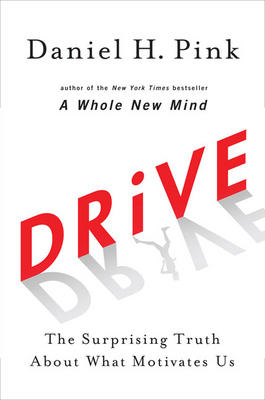
My fellow students in class know what the book is about, but for students of mine who are curious, here's the tweet from Pink: Carrots & sticks are so last century. Drive says for 21st century work, we need to upgrade to autonomy, mastery & purpose.
Autonomy is defined as freedom from external control or influence; independence. I find that high schools in particular are lacking in this part of "motivation 3.0." Motivation 3.0 is the "upgrade" from carrots and sticks (reward and punishment) that presumes humans have a "third drive:" to learn, to create and to better the world. I started thinking about autonomy and this human drive to be such last night when I was writing some homework.
I am going to start asking myself a few questions as I create homework in the future (from page 175 in the book):
- Am I offering students any autonomy over how and when to do this work?
- Does this assignment promote mastery by offering a novel and engaging task?
- Do my students understand the purpose of this assignment?
Honestly, I can say that some of my assignments definitely do not promote mastery. Section review questions and vocab are really just about rote organization of information that we've done in class. Other assignments, such as colorful essays, are a different way of showing that you have mastery of a subject. Do you have any ideas for some engaging tasks that will show that you have mastery of the topics we cover? I know that not all of you find biology to be your favorite subject, but how can autonomy and engagement improve your enjoyment of the science we cover?
What about purpose? What is the purpose of each assignment I hand out? I think the general consensus in my classes is that I'm just giving you busywork and forcing you to do pointless homework that you don't like. Well, disliking the homework aside, I always have a good reason for the assignments I give out. Even though section review homework does not wholly promote mastery, as it is pretty simple, it does have a point! The more you expose yourself to the vocabulary, the more likely you are to understand the higher level assignments!
One final point about the book is Pink's discussion about Type X and Type I behavior. Type X people are "extrinsically motivated" by things like money, grades, and other external rewards of activities. Type I people follow a different approach to life built around "intrinsic" motivations like autonomy, mastery and purpose. These types of people still think that money, grades and other external rewards are important, but they have a different drive. Type I people have an innate desire to direct their own lives, to learn and create new things, and to do better for the world they live in.
Something I knew before reading this book, but didn't realize, was that I want each and every one of my students to be Type I. I didn't have a name for it like Pink, but I knew that I wanted my students to go on and do good things in the world. And before you get out into the world to do those good things, I want you to learn. Your goal throughout your whole life should be to learn. Something in this book that will stick with me for a long time is this: "With a learning goal, students don't have to feel that they're already good at something in order to hang in and keep trying. After all, their goal is to learn, not to prove they're smart." Pink is citing another book, Self-Theories by Carol S. Dweck, that I intend to read soon.
Too often, students think they need to prove something, and they think the only way to do it is to get the good grade. I sincerely want all of my kids to take a look at their learning, and really push themselves to learn the things I teach, and not just memorize the information for the good grade on the exam. If your goal is to prove your intelligence to anyone, then you're not learning. If your goal is to "get through" the class, then you need to figure out a way to enjoy the class and get something from it. This should be true in everything you do in your life!
Friday, March 11, 2011
Subscribe to:
Posts (Atom)