I really miss yoga. Truly. The longer I go without it, the worse I feel. The longer I go without it, the harder it is to start it again! I think I need someone to do it with me, or at least someone to hold me accountable! Any volunteers? The video below is of my most favorite yoga-blend activity, it's called "Yoga Booty Ballet." One of my best friends and I did this video for several weeks one summer. It's intense, but it feels great!
I read somewhere that 21 days makes a habit. So I'm starting in the morning with this site: http://www.youtube.com/user/yogayak. I'll do yoga every day for 21 days. By that reasoning, I should have formed a solid habit by March 9th. Cheer me on!

The endeavors of a spirited teacher who hates wearing shoes. Follow me as I navigate teaching, chemistry, technology, grad school, vodcasting, blogging, horseback riding and more... all while trying to avoid traditional footwear (or shoes altogether).
Saturday, March 19, 2011

Sunday, March 13, 2011
Pink's Drive... a biology teacher's review.
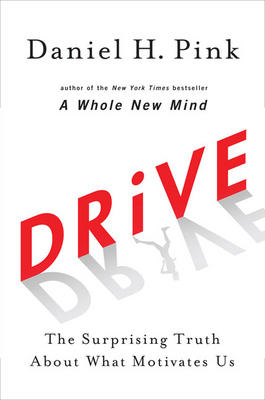
My fellow students in class know what the book is about, but for students of mine who are curious, here's the tweet from Pink: Carrots & sticks are so last century. Drive says for 21st century work, we need to upgrade to autonomy, mastery & purpose.
Autonomy is defined as freedom from external control or influence; independence. I find that high schools in particular are lacking in this part of "motivation 3.0." Motivation 3.0 is the "upgrade" from carrots and sticks (reward and punishment) that presumes humans have a "third drive:" to learn, to create and to better the world. I started thinking about autonomy and this human drive to be such last night when I was writing some homework.
I am going to start asking myself a few questions as I create homework in the future (from page 175 in the book):
- Am I offering students any autonomy over how and when to do this work?
- Does this assignment promote mastery by offering a novel and engaging task?
- Do my students understand the purpose of this assignment?
Honestly, I can say that some of my assignments definitely do not promote mastery. Section review questions and vocab are really just about rote organization of information that we've done in class. Other assignments, such as colorful essays, are a different way of showing that you have mastery of a subject. Do you have any ideas for some engaging tasks that will show that you have mastery of the topics we cover? I know that not all of you find biology to be your favorite subject, but how can autonomy and engagement improve your enjoyment of the science we cover?
What about purpose? What is the purpose of each assignment I hand out? I think the general consensus in my classes is that I'm just giving you busywork and forcing you to do pointless homework that you don't like. Well, disliking the homework aside, I always have a good reason for the assignments I give out. Even though section review homework does not wholly promote mastery, as it is pretty simple, it does have a point! The more you expose yourself to the vocabulary, the more likely you are to understand the higher level assignments!
One final point about the book is Pink's discussion about Type X and Type I behavior. Type X people are "extrinsically motivated" by things like money, grades, and other external rewards of activities. Type I people follow a different approach to life built around "intrinsic" motivations like autonomy, mastery and purpose. These types of people still think that money, grades and other external rewards are important, but they have a different drive. Type I people have an innate desire to direct their own lives, to learn and create new things, and to do better for the world they live in.
Something I knew before reading this book, but didn't realize, was that I want each and every one of my students to be Type I. I didn't have a name for it like Pink, but I knew that I wanted my students to go on and do good things in the world. And before you get out into the world to do those good things, I want you to learn. Your goal throughout your whole life should be to learn. Something in this book that will stick with me for a long time is this: "With a learning goal, students don't have to feel that they're already good at something in order to hang in and keep trying. After all, their goal is to learn, not to prove they're smart." Pink is citing another book, Self-Theories by Carol S. Dweck, that I intend to read soon.
Too often, students think they need to prove something, and they think the only way to do it is to get the good grade. I sincerely want all of my kids to take a look at their learning, and really push themselves to learn the things I teach, and not just memorize the information for the good grade on the exam. If your goal is to prove your intelligence to anyone, then you're not learning. If your goal is to "get through" the class, then you need to figure out a way to enjoy the class and get something from it. This should be true in everything you do in your life!
Friday, March 11, 2011
Monday, March 7, 2011
The changing curriculum, then and now.
How has the curriculum changed (the content included) since the 1900s? This is a question from a classmate, and I found it easy to answer with a quick google search. As far as America is concerned, it has changed with the times, and changed according to what was happening in the world (not so much about bettering the world, but about how the world was affecting the US).
Here's a breakdown of curriculum development (and its development) since the earliest part of this century (for high school):
Here's a breakdown of curriculum development (and its development) since the earliest part of this century (for high school):
- From 1893-1930s, it was up to college professors to decide what was necessary "college prep."
- by 1912, every state had a high school, but only 10% of America's youth were graduating from them
- in 1917, after some complaining from farmers and labor groups, funds were authorized for high schools to have vocational programs.
- When the depression hit, many high school graduates were not able to find work because of their "lack of preparation."
- The period from 1931-1942 saw extensive curriculum development.
- high school enrollment doubled because American youth couldn't find any jobs and therefore chose to stay on in school.
- several studies were rolling out that revealed teachers did not follow curriculum models
- teachers were also encouraged to get to know their students better so they could develop better units
- Curriculum development was shelved when America got involved in WWII.
- schools were expected to provide "preinduction training" and to provide war/military industry training
- After 1946, schools were under pressure from many different groups who had vastly different ideas on curriculum
- these included: environmental education, global understanding, free enterprise, one world emphasis, air-age education, and physical fitness. Sounds familiar, eh?
- In 1957, the Soviet Union launched a satellite into space, creating panic in the States
- had we fallen behind Russia in general skill sets and knowledge?
- in the next 15 years, more than $100 million was provided for math & science education
- textbooks and lab guides were developed that took students away from memorization and toward scientific inquiry
- In the late 1970s, the NSF (Nation Science Foundation) found that students interested in science careers liked the new courses, but most other students did not. This sounds quite familiar!
- After 1980, the structure of public high schools became very similar to what we know now.
- By the 2000s, "standards-based education" had taken a foothold
- this changed the measurement of success from "finishing 12 years" to "academic achievement."
Sunday, February 20, 2011
Gearing up for a vacation...
Why do I always feel like I'm forgetting something? My husband and I take off for Miami tomorrow, making a stop in Boston to visit a friend and commandeer a parking space for the week. I'm preeeeeetty excited. I've gotten just about everything done for grad classes, and I'm finishing up some grading for the kiddie tonight. I'm not even bringing my laptop with me... I don't think. We'll see I guess. I don't know if I can go a whole week without being directly connected to the thing!
We're staying at my sister's new South Beach apartment... 20th floor, jacuzzi, nearly 360 degree view of Miami, the beach, the bridge and the islands. *sigh* Delightful. We'll also be doing a day trip to the Everglades, and probably spending a day or two in Key West (probably one of the neatest places I've visited!).
I hope everyone else has a lovely vacation relaxing and and rejuvenating and at least TRYING to get out of the house! I know I ws about to go crazy with all the snow in Houlton!!! I'll take lots of pictures, and maybe I'll bring back some cool stuff for my classroom!
Have a delightful break! See you in March!
We're staying at my sister's new South Beach apartment... 20th floor, jacuzzi, nearly 360 degree view of Miami, the beach, the bridge and the islands. *sigh* Delightful. We'll also be doing a day trip to the Everglades, and probably spending a day or two in Key West (probably one of the neatest places I've visited!).
I hope everyone else has a lovely vacation relaxing and and rejuvenating and at least TRYING to get out of the house! I know I ws about to go crazy with all the snow in Houlton!!! I'll take lots of pictures, and maybe I'll bring back some cool stuff for my classroom!
Have a delightful break! See you in March!
Sunday, February 13, 2011
"New technologies result in ubiquitous connectivity and the pervasive proximity of unstructured relationships."
This is a quote from Curriculum 21, in which the author talks about "5 socio-technology trends" that are changing everything about how we learn and about how we teach. I really enjoyed the ridiculous use of thesaurus in that particular sentence quoted in my title, but on top of that, the message is very real to me, and it should be to you students. What she is saying is that all of this new technology (iPads, iPods, laptops, smart phones, etc.) gives us a stream of data and information that we are almost incapable of escaping. Have you ever tried to go a day without your phone? Or even a couple hours without your laptop open streaming a Netflix video? It's frightening to think that we are crippled without the technology, and, in a way, crippled by the technology. What I am trying to reference is the "unstructured relationships" that are becoming universal in their accessibility. When I think about life before I had a cell phone, it reminds me of a time when I would have to memorize my friends phone numbers and I would call them to have them come over.
When I think about life before a cell phone with unlimited texting, I remember calling my friends just to say hi and to chat about nothing... I remember the sound of a human voice, too. I am exaggerating to a point here, because we still have real human interactions every day. But when you receive/send more than 1,000 text messages in a day, maybe it's time to take a step back and think about what you're missing. Skype, iChat, AIM and other instant-messaging services have altered our interactions that much further. It is useless for teachers and parents and others of the "landline generation" to resist this change. But it is wholly possible for us to do something positive for the generation that must navigate, sometimes blindly.
I think that the one thing I'd like to talk about more specifically is the social network. No, not the movie. Social networks such as Myspace and Glogster are very new on the timeline of technology and human evolution. The "iGeneration" has not lived in a time when Facebook and Twitter were not around. It is very easy for the landline generation to put down these social networks, and to block them in schools across the country. And yet, Facebook has some 200 million users across the world. YouTube, another form of social networking, is blocked and banned in many schools too. Why?
These social networks have so much potential in the community of learners, it is merely our responsibility as teachers to grasp it, understand it and use it to benefit our learners. The possibilities are endless, and the amount of knowledge you can choose to share or not share is unlimited. Facebook has over 24 million photos uploaded every day. Who's to say that 30 of those photos couldn't be from a really great lab that we did about bacterial transformation? Or that 10 of those photos are from a student who was assigned to take photos of science creeping into their every day life?
Status updates have evolved since 2003 when Facebook launched, but the idea is still the same: what's on your mind? Is there any reason a child shouldn't be allowed to update their status to say "wow, just discovered that I have a Hitchhiker's thumb and can taste PTC paper. What about you?" Is there any reason that a teacher can't post the homework as a status update? "Biology, don't forget to do Chapter 6 vocabulary and study for the quiz on meiosis." What about posting a status update for students to reply to with thoughtful conversation and insight? "Class, please read the article linked here. Respond to the article with your thoughts and additional research below. Keep your response concise while bringing in new information for the group."
The possibilities are there. We just need to open our minds to the idea that we can trust students with this responsibility. We must allow them to work in the medium that they will have to use the rest of their lives. Who better to guide them than a teacher?
Share your thoughts in the comment section below, I'd love to hear your opinion.
When I think about life before a cell phone with unlimited texting, I remember calling my friends just to say hi and to chat about nothing... I remember the sound of a human voice, too. I am exaggerating to a point here, because we still have real human interactions every day. But when you receive/send more than 1,000 text messages in a day, maybe it's time to take a step back and think about what you're missing. Skype, iChat, AIM and other instant-messaging services have altered our interactions that much further. It is useless for teachers and parents and others of the "landline generation" to resist this change. But it is wholly possible for us to do something positive for the generation that must navigate, sometimes blindly.
I think that the one thing I'd like to talk about more specifically is the social network. No, not the movie. Social networks such as Myspace and Glogster are very new on the timeline of technology and human evolution. The "iGeneration" has not lived in a time when Facebook and Twitter were not around. It is very easy for the landline generation to put down these social networks, and to block them in schools across the country. And yet, Facebook has some 200 million users across the world. YouTube, another form of social networking, is blocked and banned in many schools too. Why?
These social networks have so much potential in the community of learners, it is merely our responsibility as teachers to grasp it, understand it and use it to benefit our learners. The possibilities are endless, and the amount of knowledge you can choose to share or not share is unlimited. Facebook has over 24 million photos uploaded every day. Who's to say that 30 of those photos couldn't be from a really great lab that we did about bacterial transformation? Or that 10 of those photos are from a student who was assigned to take photos of science creeping into their every day life?
Status updates have evolved since 2003 when Facebook launched, but the idea is still the same: what's on your mind? Is there any reason a child shouldn't be allowed to update their status to say "wow, just discovered that I have a Hitchhiker's thumb and can taste PTC paper. What about you?" Is there any reason that a teacher can't post the homework as a status update? "Biology, don't forget to do Chapter 6 vocabulary and study for the quiz on meiosis." What about posting a status update for students to reply to with thoughtful conversation and insight? "Class, please read the article linked here. Respond to the article with your thoughts and additional research below. Keep your response concise while bringing in new information for the group."
The possibilities are there. We just need to open our minds to the idea that we can trust students with this responsibility. We must allow them to work in the medium that they will have to use the rest of their lives. Who better to guide them than a teacher?
Share your thoughts in the comment section below, I'd love to hear your opinion.
Thursday, February 3, 2011
If you had the choice, what would you learn about?
Thinking about curriculum is beginning to upset me. I'm having these horrible thoughts like "am I really teaching the students?" or "am I really teaching what matters?" or, worse, "will they be able to perform well on the SAT because of what I taught?"
Ugh. Surely some things are working, right? I think my learning goals and objectives are well-aligned with "state benchmarks" and the school's mission. Perhaps some of you don't even realize that when you're working through a lab or experiment, you are improving your problem-solving skills! The science fair has started, and you are, in groups or solo, working through obstacles in your thought processes and adjusting your procedures to work perfectly. My sneaky hope is that you'll become better scientists and more "tuned in" and interested in science!
Another last thing that works, at least in my science classroom, is the wide variety of assessments and computer activities. Be honest, how many days of class have you had with me where we didn't use the MLTI laptops? Even some of our assessments (quizzes, exams, lab reports, etc.) are online! I have to tell you, I really wanted to use NoteShare for lab reports, but I just couldn't get it up and running in time... maybe next year! Even so, I'm pretty excited about how labs are going in class. I'm wicked excited to start doing some fruit fly work (see attached video) as we start rolling into genetics and natural selection!
One last thing I want to talk about is what I know: personalized learning in the science classroom. I think you kids can comment on this more than I can, so feel free to post below! I hope that I am doing my best for all of you, and, despite the numerous things that don't work in a given school system, that I am giving you the very best of scientific information. You may not know all of the things I do in a daily class/lesson, but I work very hard to customize the learning. I know that not everyone wants to learn about the cell cycle, and I know that not everyone wants to learn about the intricate and specific mechanisms behind cell signaling. But for those that do want to know these things, I try to keep it interesting and varied. I also try to keep things riveting for the kids that aren't exactly fascinated by this stuff. Because, who knows? You may learn something new that you never thought you would find so cool!
So I come back to the question in this title: if you had the choice, what would you learn about? Teachers are faced with fulfilling a curriculum based on many different things. Sometimes it seems as though it is not really about your needs, wants and desires. This is an open-ended question, and one that I want you to answer honestly. I'm not going to give you any suggestions on how to answer, I just want you to think about the question. Another way: if money were not an option, and you could learn at your own pace, what would you go to high school to learn about? (Or middle school.) And, if you care to elaborate... what would your schedule be like?
Click here to answer anonymously!
Click here to answer anonymously!
Subscribe to:
Posts (Atom)